Search This Blog

Showing posts with label Brute Heart. Show all posts

Monday, September 11, 2023

I Suppose I Could Do Something Like This


or this

 if I didn’t hate promoting my writing.

I know this is naïve, some would say stupid, but I am uncomfortable mentioning to people I meet that I have published two novels and a children’s book. To me, it’s a form of bragging. Mentioning I’m a writer also makes them feel obligated to buy one of my books, pay me $5 to $15, even though they receive something in return. (Something of value, I hope.)

I grew up scrambling for money, and thanks to the work ethic my father instilled in me, I have never had to ask for money except when getting a mortgage. I don’t write to make big bucks, which is a good thing, considering the miniscule royalty payments I receive. I write because I love playing with words, telling stories, creating metaphors and other connections that give my brain an occasional shot of dopamine. If readers happen to find my work entertaining, I’m happy.

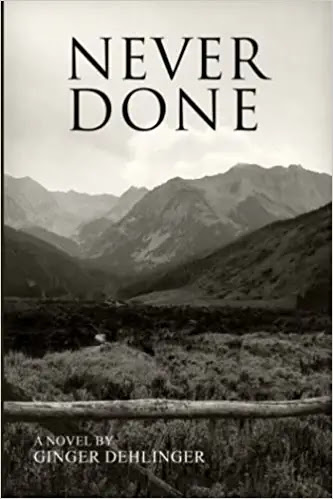
That being said, Sandra Beckwith, who gives all kinds of good advice to writers, recently shared her enthusiasm for MockupShots, the company that created (as a free introduction) the two Never Done promotions above. For a reasonable fee, they insert book covers in a variety of settings for use in ads or other promotions. Although I didn’t subscribe to the service, I did appreciate the idea, so just for the fun of it, I tried creating mockups of my own.


It quickly became apparent that if I ever need a mock-up promotion, I should leave it to the professionals.

Saturday, October 8, 2022

The History Major

I was a history major at the University of Oregon. When I graduated, applicable careers for a history major were limited unless you taught the subject, which I did at the high school level for six years. Then, after divorcing my first husband, I moved to the East Coast and spent the rest of my Jill-of-all-trades career hopping from job to job, looking for, but never finding, work that held my interest longer than six or seven years. None of the positions I held were remoted related to my major.

Then, I retired. Suddenly I had time to write something other than business letters, reports, or training manuals. I could set my own deadlines, choose topics limited solely by my imagination, and though I had abandoned my major for 35 years, it crept into much of what I wrote.

The story in my first novel, Brute Heart, takes place in the 1970’s and 80’s. In it, I expose the challenges of a young woman trying to gain acceptance as a veterinarian in agrarian communities unaccustomed to females in that profession. I also describe the highly complicated regimen imposed on people during the early years of Oregon’s Death with Dignity Act.

Never Done, my second novel, is set in Colorado from 1885 to 1919. Based on the life of my great-grandmother, the story is about a woman's perseverance as she raises a family and moves from cattle country to mining towns, witnessing industrialization, World War I, and the Spanish flu epidemic.

“A nation that forgets its past has no future,” said Winston Churchill. I believe this blindness to the lessons of history is taking place in the United States right now. Call me a paranoid geezer, but I would describe most Americans as complacent, almost as ignorant of the real world as they were prior to World War I, especially when it comes to Russia, North Korea and China. Not having a strong President adds to the danger of being drawn into another large-scale war.

American parents are also betraying an entire generation by turning their backs on even the mildest version of “spare the rod, spoil the child,” mollycoddling too many of today’s children, failing to prepare them for the realities of life. I blame this on the alarming increase our country is experiencing in drug use and suicides among young people.

I can’t pin a rose on me, however, since I rarely tackle contemporary issues in my writing. Instead, I hunker down in my comfort zone which is writing about my own history or that which preceded me. Those years definitely weren’t problem-free, but at least most people who lived them were better prepared to deal with poverty, disease, war, and natural disasters.


Thursday, August 4, 2022

August 21 is Poet's Day

When I retired with the intention of doing what I call serious writing, I started slowly by taking an online children’s literature course. Although none of my writing assignments ended up in Brute Heart, I moved from playing with children’s stories to self-publishing my first novel.

To hone my skills and feel more like a writer, I joined Central Oregon Writer’s Guild. This led me to a critique group that gave advice as I slogged through the research and writing that went into my second novel, Never Done. Two members of my critique group were poets who shared their work every other week. I learned a lot from them as I read what they wrote and offered suggestions, tentative ones, to be sure. I grew a bit bolder and wrote a few poems of my own which they graciously critiqued. I wrote about whatever came to mind, some poems celebrating nature, others whimsical. I also read Sylvia Plath, Mary Oliver, Edna St. Vincent Millay, which gave me a greater appreciation for the genre.

Due to job changes and members moving out of town, after five years, the group disbanded. I kept writing. “No more novels,” I declared, as I concentrated on short stories and poems. I guess I had become a poet and didn’t know it, because as of this August (2022) 29 of my poems have been published, some in online journals, most with other poets in soft cover anthologies. I've been told my poems are easy to understand. More prose than traditional poetry, they flow freely, rarely rhyme.

Since August 21 is Poet’s Day, I decided to celebrate another poet by sharing the poem I read at my mother’s graveside service in 2016. I did not write this poem, but wish I had.

Although You're Gone

Although you're gone, I'm not alone,
And never shall I be,
For the precious memories of the bond we shared
Will never depart from me.

Our love surpassed the ups and downs
And helped us along the way,
And that same love will give me strength
To manage this loss each day.

On my mind and in my heart,
Mom, you’ll forever be,
For as much as I am a part of you,
You are a part of me!

© Shannon Walker


                P  O  E  T  R  Y

Friday, October 9, 2020

Writing About Nature and Loving It

 Nature Writing

One of my favorite writing moments is coming up with ways to describe a sunset, weeds, animals, even dirt, using what I believe to be interesting words or combinations of words. That can be hard to do without reverting to "purple prose," which makes writing something unique about nature a  challenge.

No matter what I write--story, poem, novel--nature plays an important part in the setting. I may struggle with the plot or some relationship my characters are having, but I usually relax when I get to a place where I can interject a description of clouds, animals, water, trees, etc.

While my husband and I still had a cabin at Lake of the Woods, Oregon I was asked to write a chapter on the area's flora and fauna for a comprehensive history of the lake and its surroundings. The book was published in 1918 as Cabin Cruising, a Lakeside History. Below is one of the paragraphs I wrote for it.

The lake itself supports a variety of waterfowl. Some nest here. Others make it a stopping point during migration. From the campgrounds, resort, or lakeshore you can watch an osprey, similar in size yet whiter than an eagle, fold its wings, dive into the water feet first, and come up with a fish. Also seen on or near the water are great blue herons, Canada geese, grebes, buffleheads, and sandhill cranes. Occasionally a flock of American white pelicans will land on the lake. How delightful it is to experience these snowy birds with huge orange beaks use their nine-foot wing spans to soar through the air with the grace of birds half their size!

In 2011, I won a prize for a nature essay on tumbleweeds. Here is an excerpt.

Upwind from the road, a lone tumbleweed about the size of a bear cub bounded across the scant vegetation and over the crest of a gentle rise where it paused for a few seconds before leaping into the air and bouncing across the road. Strong-limbed, and with a few seeds left to sow, the tumbleweed rolled up the ditch bank into the waiting arms of a cluster of weeds with similar heritage, weeds stacked three feet deep against a barbed wire fence that shadowed the road as far as the eye could see. The thick pile of weeds made for a soft landing, but the thorny arms therein refused to let go, and the hapless tumbleweed’s gypsy days were over.

The story in my novel Brute Heart takes place in several natural settings. Most are in eastern Oregon. The one below describes a forest west of the Cascades.

The thick tangle of evergreen and deciduous trees embraced every imaginable shade of green, from the green-black undersides of the fir boughs to the chartreuse velvet moss that wrapped around the tree trunks and clung to the tops of rocks in the streambed. Vine maples, with sleeves of new green foliage, stretched across the rapidly moving water, their arms so long they sometimes entwined with limbs from the opposite side of the stream to form a leafy canopy.

I included more nature writing  in my novel, Never Done, published in 2017 by the Wild Rose Press, a turn-of-the-century story that takes place in western Colorado.

The plip, plip, plip of melting icicles signaled the beginning of what amounted to spring in Ophir Loop. A misty rain, hard to distinguish from low clouds, hovered over the gorge once or twice a week. Snow was still being measured in feet above the timberline, but bursts of wild green dusted the slopes. The creeks had begun gurgling again, and the pussy willows growing along their banks were silver with catkins.


Every once in a while something on Facebook resonates with me, and I save it for future use. How appropriate this one is for a post on nature writing! 


Wednesday, September 4, 2019

Getting Those All-Important Reviews

     While I was in the process of writing my first novel I sometimes caught myself imagining the thrill of reading a review of my book in one of the local newspapers. Sometimes that thrill would turn to dread when I pictured a negative review, but I still wanted the feedback and publicity. My wildest dreams were not wild enough to expect a review in the New York Times or even The Oregonian, however I did believe the Klamath Falls Herald and News and The Bulletin in Bend would print one. After all, most of Brute Heart takes place in Klamath Falls and I was a long-time resident of Bend. How naïve of me! Local newspapers simply do not have staffs large enough to read and review books by local authors or even established authors. The reviews they do print are written by staffers working for the New York Times News ServiceLos Angeles TimesNewsday, etc.
     I was also shy about asking friends or family members for reviews of my first novel. But that disappeared by the second novel. By the time Never Done was released I was bolder and armed with a better understanding of the relationship of reviews to sales. Since then, when someone compliments either of my novels I say, “May I ask a favor? If you enjoyed the book, will you please write a review on Amazon?” (or Goodreads if they have an account) I only have 10 reviews for Brute Heart but as of today, 37 for Never Done.
     A few of the people I asked for reviews said they couldn’t figure out where to write a review on Amazon. So-o-o-o, I wrote an instruction sheet.

                                    How To Write a Review on Amazon

  • Under the book's title, Kindle Edition, you will see the current number of customer reviews.
  • Click on that link.
  • You will see a bar graph picturing the number of stars the book has received so far.
  • Below the graph is the "write customer review" box. Click on that.
  • Five empty stars will appear.
  • Click on the star that best fits your opinion of the book with five being highest.
  • You may insert a photo at the next prompt, but it is optioal.
  • Next, Amazon would like a headline from you: a brief overall statement of what you think is most important for a potential reader to know about the book.
  • After writing the headline, please write your review in the space provided.
  • Don't forget to click "submit" at the very end.
It isn’t necessary to write a long review. Potential readers often skip long, detailed posts. They just want to find their next book and get started on it.

     Never Done has been in print for over two years now, so I rarely get a new review. Nevertheless, I am thrilled with those I have received and still ask for a review if a situation seems to warrant it.

Friday, July 5, 2019

Spell Or Use Numbers When You Write


Most writers—including me—like to write for three reasons: We’re creative, we love to read and because we hate working with numbers. Eventually we find out that even in writing, numbers find a way to sneak into our work.

There are several rules of thought on how to handle writing numbers, but the most common is pretty simple. Spell out numbers under 10 (zero through nine), and use numeric symbols for 10 and up. I brought two puppies home from the poundDuring my lifetime I have adopted 12 dogs.

Of course since we are using the English language, there are exceptions to the rule. For example, spell out all numbers that begin a sentence. Twenty-two thousand people were killed in automobile accidents in 2001. Most of us don'e feel like writing such long numbers, and readers don't enjoy reading them, either. Better to write: Automobile accidents took the lives of 22,200 people in 2001.

Another exception is calendar years. Always use numerals when writing them even at the front of a sentence. 1997 was the year I was born. Another instance where rule #1 doesn’t apply is when writing peoples’ ages. (“She is only 4 years old”). Also when writing dates (December 25), cash ($5), percentages (25 percent) and ratios (100-to-1).

Let's say you want  to include the numbers four and ten in the same sentence. Normally you would write out the word "four" in: "Gary graduated from high school in four years." When adding a number that needs to be expressed as a numeral, use numerals for both: "Gary graduated from high school in 4 years, but it took him 10 years to graduate from college and med school."

Now, even though you might never have been a math whiz, you can be an expert at using numbers in your writing.

Saturday, April 6, 2019

April is National Poetry Month

When I retired and began writing for fun and not-to-be profit, my focus was prose. I spent close to ten years writing and promoting my novels "Brute Heart" and "Never Done." I also wrote a few essays and short stories.

During that time I also joined a critique group. Inspired by two members of the group who were poets, I started playing around with poetry. I quickly learned rhyming poetry was passe. Today's readers and editors prefer blank verse or free verse. Unfortunately, most of my early attempts at writing poetry were full of lines that rhymed. Sometimes rhyming words showed up even when I made a conscious effort to avoid them.

For the last year or so I have been submitting my work to online magazines, and surprise, surprise, 5 of my poems have been published. Who'd a thunk it? One of the chosen poems even rhymed.

Since April is National Poetry Month I decided to post a poem I have written. This poem, an example of blank verse, has not been accepted for publication. I have submitted it several times, but thus far, no interest.


A Rose Is a Rose Is a Weed

Noble bloom, pride of queen and pharaoh,         
     centuries of breeding grace your face.
A blueblood now your palette runneth over
     on velvet petals crowning shapely legs.
    
But ancient meadows tell of baser roots,
     of tangled limbs and blossoms pale and small,
a prickly past your breeders cannot stem
     nor halt the thorny legacy you bear.

Aristocrat of weeds, your rowdy cousins                                           
     ambush country fences, blight the harvest.
Outlaws from distinguished family tree
    or spoilers of your pretty pedigree?

You blush at such denouement (tres outré!)
     and pucker lipstick petals for a kiss,        
seducing those naïve to the deception
     with mesmerizing breaths of French perfume.
                                                Ginger Dehlinger

Friday, March 8, 2019

Fun With Grammar

After posting several months about the days of the week housewives traditionally did specific chores, I decided it was time for lighter fare. Below are some humorous takes on a few weird aspects of English grammar.


Sunday, January 7, 2018

Where I Write


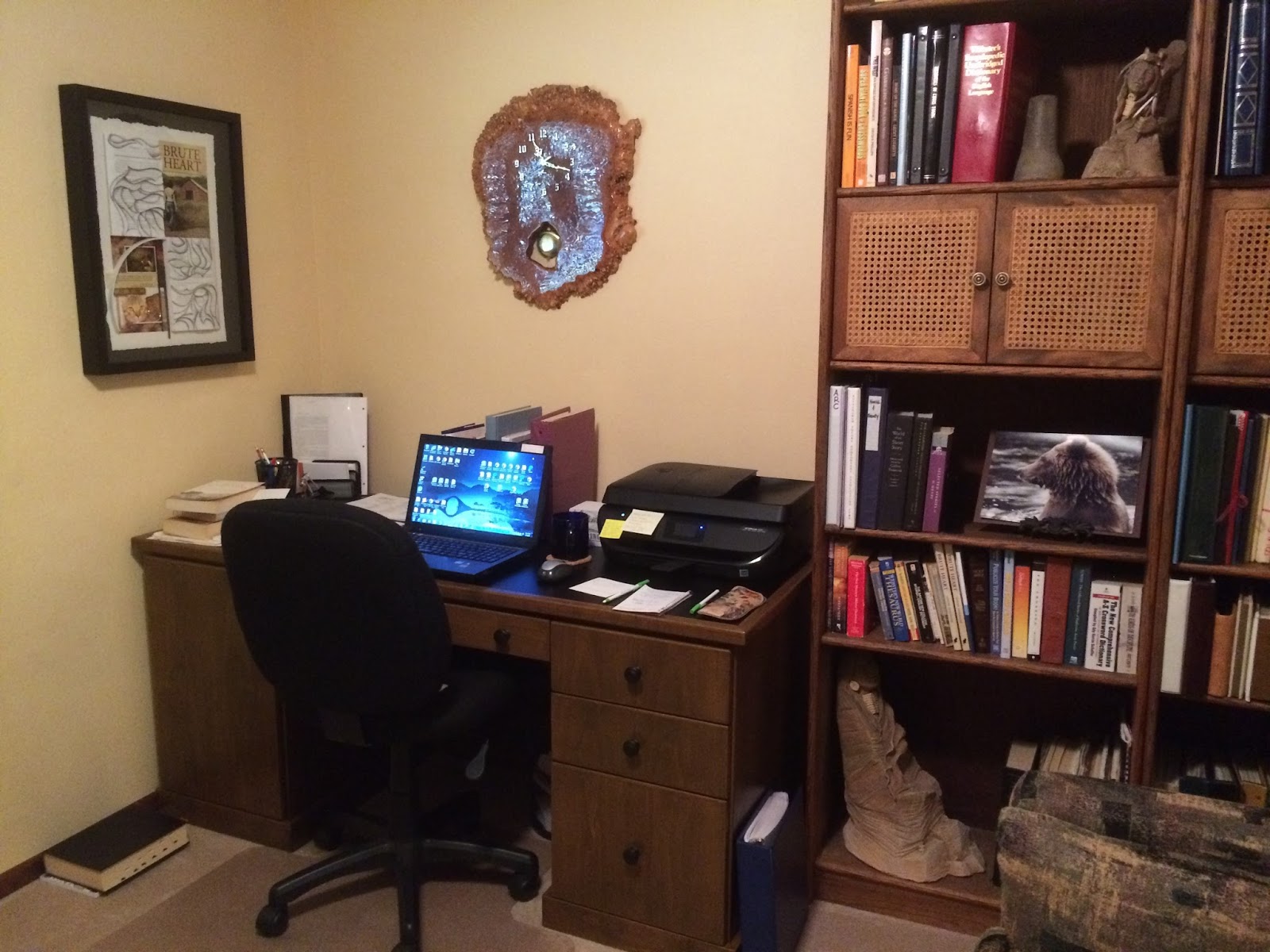
Here is where I spend a few hours of most of my days. I take up roughly one quarter of the small third bedroom my husband and I refer to as the den. In addition to my writing corner, the den contains bookcases, a sofa, and a great chair to sit in and read. My writing space is always messy, but I know  where to dig for what I need.


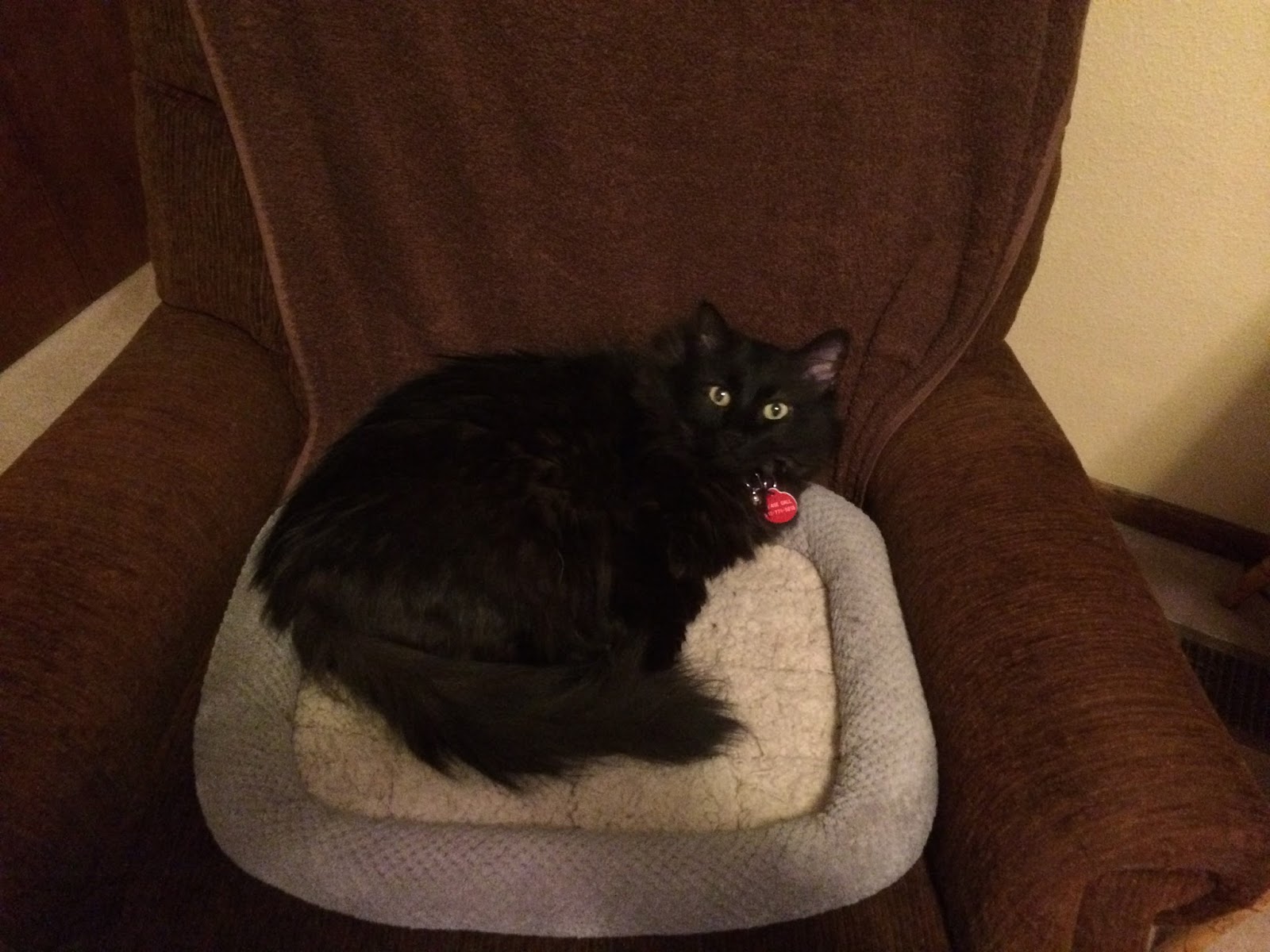
In the reading chair, usually asleep, is Kiki, my writing buddy. I think the sound of my typing soothes her. On the other hand, she sleeps most of the time.


On the wall in front of me is a clock my cousin Arlin Phillipps (Arlie) made from a large burl. He removed the burl from a tree, sliced it, and coated it with fiberglass resin. After the resin dried, he added numerals, hands, and a pendulum. Pictures don't do it justice.


To the left of my work space hangs a framed book carving of my novel Brute Heart. When I saw the artist's work at an art fair, I just had to have her create this beautiful three-dimensional heirloom. The artist, Sarah Bean, lives in Gold Beach, Oregon. Many of her book carvings hang in the Library of Congress.

The process is rather difficult to explain. First Sarah separates a soft cover book into two halves. Then she uses some kind of very sharp cutting tool to carve intricate designs into the pages, going deeper with some cuts than others. Finally she adds the cover, pictures, and miscellaneous small items to create a collage representing the physical book as well as the story within. Someday I am going to have Sarah make one for my second novel, Never Done.

Tuesday, November 7, 2017

Pinterest

Pinterest is a photo-sharing website that is enjoyable and informative. Type almost anything in the "search" window and you will be directed to pictures of it. I enjoyed the experience so much I created boards representing my two novels--Brute Heart and Never Done.

In my writing I try to describe people, places, and things well enough for readers to visualize them, but  now they can go to my Pinterest boards and see actual pictures in some cases, close approximations in others. They will never see pictures of the characters, though. The people in my stories need to be assembled in each reader's imagination.

Below are a few pictures from my Pinterest boards. To see more go to https://www.pinterest.com/gdehlinger/ 


Thursday, July 10, 2014

What's It About?

Whenever I tell someone I've written a novel, their first response is almost always, "What's it about?" Most authors are ready with a simple answer to this question; however when I tell people Brute Heart is about a young veterinarian who's deciding whether to euthanize her terminally ill father, I can't seem to stop with that. I think it's because I'm afraid of horrifying potential readers, notably those who love their fathers. 

So I yammer away, adding details such as:
  • Her father is an alcoholic. (He's not the perfect father.)
  • He's been mentally and physically abusive to her and her family. (far from perfect)
  • I usually add, "not sexually abusive." (No salacious details in this story.)
 If what I've said so far still produces a blank expression, I might add:
  • The father can't understand why his daughter won't do for him what she does for an old or wounded animal.
  • Then I feel compelled to mention the young woman had to work her way through college and veterinary school, and if she were caught she would lose her hard-won license and end up in prison.
Soon whatever interest this person may have had is replaced by a polite nod once in a while followed by a reason they have to leave. As usual, I've said too much, and it still wasn't enough.

If you've read Brute Heart, what would you say if a person asked you, "What's it about?"

Tuesday, August 30, 2011

It Is So-o-o Hard to Get a Book Reviewed

FLASH: March 27, 2012. Brute Heart finally gets the review listed in right-hand column.

While I was still writing Brute Heart, I would sometimes catch myself imagining the thrill of reading my book reviewed in one of the local newspapers. Sometimes that thrill would turn to dread when I envisioned a review that ripped my book apart, but I still wanted the feedback. My wildest dreams were not wild enough to expect a review in the New York Times or even The Oregonian, however I did believe the Klamath Falls Herald and News and Bend's paper, The Bulletin, would print one since most of the story takes place in Klamath Falls and because I'm a long-time resident of Bend. How naive I was! Local newspapers simply do not have staffs large enough to read and review books by local authors or even established authors as exemplified by the bylines (New York Times News Service, Los Angeles Times, Newsday, etc.) that accompany the few book reviews found in most of today's local newspapers.

Lee Juillerat, Regional Editor for the Herald and News, did publish a wonderful article announcing my book signing at Borders, but no review, even though he read the book. After reading his article I asked him what he thought of Brute Heart and he replied, "I did enjoy the book. Found myself reading longer into the evenings than I intended to find what came next. I appreciated that your story wasn't strictly formula and that you took some risks, which made the story far more involving. Nicely done." And that, ladies and gentlemen, is the closest thing to a professional review I have thus far received.

So, what about book signings or readings? I thought surely local newspapers would write articles announcing such events, but other than the Herald and News, that has not been the case, in fact the Medford Mail Tribune told me their policy excludes book signings but does cover readings as long as the author lives in their area or has a strong national following. Other papers announce readings and signings in teensy blurbs found in community calendars, "This Weekend's Events," etc.--lists that include the bare minimum of facts and appear in obscure sections or supplements.

When the Central Oregonian, Prineville's newspaper, ignored my press release announcing a book signing and reading at Book 'N Bean, I wrote an article titled, "There's a Book in You" for Horsefly, a free monthly with a similar reach. Although the overt purpose of the article was to encourage people to write those stories that had been floating around in their heads for years, I was able to plug Brute Heart several times and include the date, place and time for my Prineville book signing. This technique can also be used with a larger newspaper by writing an op ed (an article that includes your opinions and appears opposite the editorial page) on some topic related to the theme(s) in your book. You can either refer to your book within the article itself or include it in your signage, for example: by Ginger Dehlinger, author of Brute Heart.

In summation, my advice is to have realistic expectations but keep sending those press releases. You might get lucky if your press release includes a well-written synopsis that the paper can print without having to edit it. Submit your own articles or opinion pieces, and don't overlook niche publications that may be more receptive to smart material that fills pages and provides reader interest.

Sunday, April 3, 2011

Genres

Whether you are a reader or a writer, at some point you are going to encounter the term, genre. I've often wondered who first borrowed this word from the French, and why it has become the standard replacement for "classification," "type," "family," "category," or some other common word. I figure it must have been the same type of person who pronounces tomato with a flat as opposed to a long A.
Genrification (I love making up words) appears to be a natural tendency. Aristotle believed there should be at least two genres: comedy and tragedy, and Plato further divided literature into drama, poetry, and prose. The number of genres grew hand in hand with the development of more literary forms as well as the technology to support them, especially movies.
It is often difficult to define a book's genre because some books fit more than one and because there are now so many sub-genres. In the world of books, the two most obvious categories are fiction and non-fiction, each containing numerous genres and sub-genres. Some of the more popular non-fiction genres are memoir, how-to, self-help, and biography. The best-selling fiction genres are mystery, romance, sci-fi, horror, suspense, and Western, the latter being in decline since the 1970's. If you are interested in a more complete, although not exhaustive list of genres and sub-genres along with brief descriptions and examples, send an e-mail to gdehlinger@live.com and I will attach my research on this topic with my reply. It is too much information for a blog post. Another helpful list which includes other literary terms can be found at http://www.virtualsalt.com/litterms.htm This compilation was created by Robert A. Harris.
An important thing to keep in mind is that putting books or other creative writing into categories is highly subjective, and it is often the publisher, not the author, who determines a book's genre. I could really use some of this professional advice for Brute Heart, my women's fiction/hardship to recovery/contemporary Western/family drama. :)

Monday, November 29, 2010

Why Do We Write?

My writing group, the High Desert Sojourners, is a collection of wannabee writers, some published, that meets monthly to listen to one another's work, give constructive criticism, and provide support. We bring to the meetings what we're working on or something we have written in response to a prompt distributed the month before.

At our September meeting, the writing prompt for the month of October was, "why do we write?" Since I attended a workshop that month led by Paulann Petersen, Oregon's Poet Laureate, I presented a poem I wrote instead. I was intrigued, however, by "why do we write," and decided after the meeting to address this thought-provoking question in my blog.

I started writing Brute Heart to kill time, with no plot or purpose in mind, let alone a novel. After I had written several short pieces, I saw certain similarities in theme and setting that, with some work, had the potential to be a larger undertaking. At that point my writing took on a life of its own as a research project and a puzzle being assembled from many pieces. I could lose myself for hours, experimenting with a word or group of words until I was satisfied with the clarity, meaning, sound, richness or cadence. Being a lover of words and their limitless potential, writing Brute Heart eventually became my shrink, my hidey-hole, my self-satisfaction, and my nag.

Over time I cobbled together a rough story followed by characters to support the story. Occasionally the characters I created changed the story as did happenings in my life or in the news. All of this greatly expanded the number of puzzle pieces, but finally gave me the picture on the box, and as the story took shape, I began wondering if there might be a higher purpose for what I had written. Since my novel centers on alcoholism and abusive relationships, perhaps one or more persons living with an alcoholic or abuser would find help in the story of a young woman who manages to escape both dependencies, so I kept this in mind as I continued to write.

At some point I began to believe I might have written something worthy of being shared with the reading public. I started paying closer attention to how novels were constructed and what my story had in common, if anything, with those that were successful, which led to a total reevaluation of what I had written. Characters were added or changed, chapters were added, changed, or repositioned, and massive doses of wordsmithing took place in rewrite after rewrite. Now I was no longer writing for something to do or the pure pleasure of playing with words, I was writing for the reading public, and it wasn't nearly as much fun.